Reading translation of the Spanish ballad quoted below; the line breaks follow that text.
Sir Tristan lies wounded
By an evil lance-thrust:
His uncle the king dealt it
Out of jealousy toward him;
The iron head is in his body,
The shaft still quivers outside.
Queen Iseult comes to see him
In his wretched misfortune.
Mouth joins with mouth
For as long as a mass is said.
One weeps, the other weeps,
They bathe the bed with tears.
There a plant springs up
That was called the lily:
Any woman who eats of it
Straightway feels herself with child.
Queen Iseult ate of it
In her wretched misfortune.
The Legend of Tristan and Iseult (Isolde)
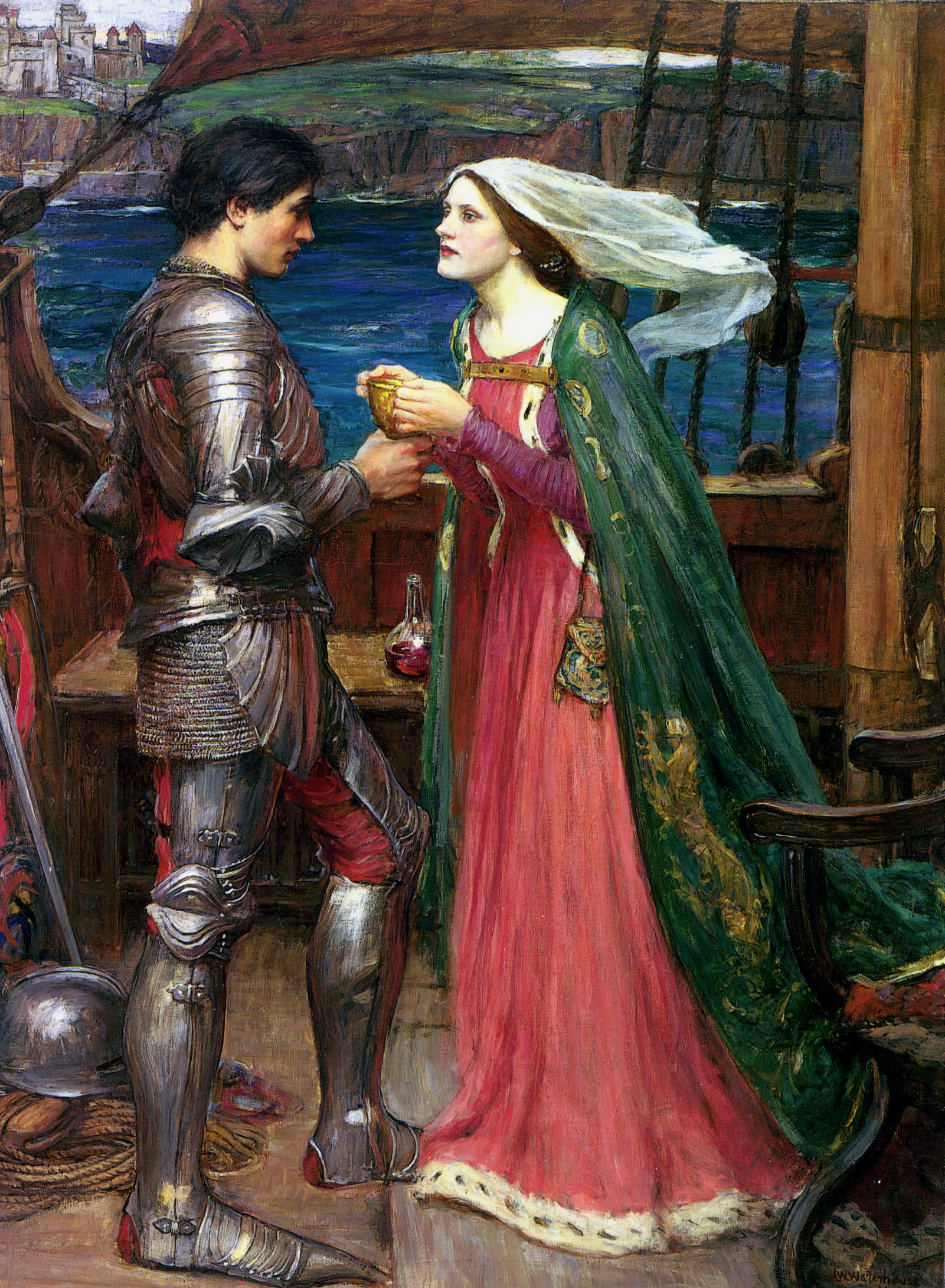
Source: Wikimedia Commons. Public domain.
The spread of the legend within French narrative marks a shift of interest away from the retelling of Greco-Latin stories and toward stories originating in Celtic culture. The appeal of Celtic mythology perhaps lies in its insular setting, its novel non-Christian symbols, and in an Otherworld that could be entered without dying, since real beings coexisted with extraordinary and supernatural figures.
The Magic Potion
The famous and frequently cited magic potion drunk by Tristan and Iseult is an original element in the narrative that has no known earlier precedents. It is likely that, given the Christian and feudal environment in which the story circulated, the potion serves as the excuse that allows the lovers' transgression to be pardoned: the adultery and the betrayal.
"My lord, upon my faith, she loves me truly, but you cannot understand the reason: if she loves me it is because of what she drank. I cannot part from her nor she from me — I cannot hide it from you." (Béroul's version)
Strictly speaking, it is not the adultery itself that surprises and scandalizes the audience, because indeed, from the earliest troubadours onward the fact was accepted and even idealized, though it was always the consequence of an arranged marriage. The peculiarity of the work lies in the fact that love is a conflict between the lovers themselves and the society to which they belong, a conflict they must confront again and again. For Tristan's love does not conform to the chivalric ideal; on the contrary, he desires only to love Iseult and loses all interest in the life of a knight.
Tristan's Antisocial Love and Iseult's Contradictions
From this perspective, Tristan's love is antisocial because it breaks the norms of courtly society and leaves King Mark's court without its finest vassal.
The figure of Iseult is literary but also deeply human. She inherits from her mother the gift of healing mortal wounds caused by mysterious poisons. She is fair-haired and beautiful. She is always clear-headed, mistress of herself, and she continually guides Tristan's steps like an inspiring force. She is skilled with words, bold, cunning… yet often selfish and just as often deceitful. She is entirely capable of leading a double emotional life as Mark's wife and Tristan's lover. But she is a woman in love, and therefore impulsive, and at times insecure and downcast. The contradiction in Iseult is part of the solidity of the character, who must confront two simultaneous realities: on the one hand, an overwhelming and transgressive passion at her lover's side, and on the other, the security of life beside her husband, the king.
Other links
Available editions of Tristan and Iseult