---
title: Triskel (triskelion)
description: Commentary on the Celtic triple spiral.
author:
name: Graciela Paula Caldeiro
url: http://graciela-caldeiro.idoneos.com
canonical: https://mitologiacelta.idoneos.com/en/triskel/
source: en/triskel/index.md
---
The triple spiral
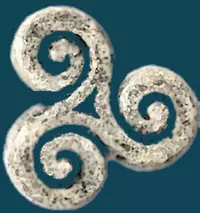
This sign, often known as the **Celtic spiral** and so closely identified with the ornamental features of the craftwork of that culture, might be compared to the **swastika**. Like the latter, the triskel is not of European origin either, but Asian.
The Celts made great use of the triskel, especially in Ireland. It should be noted, however, that the sign was already in use in Ireland even before the arrival of that people (representations of triskelions have been found in the megalithic engravings of Newgrange).
Celtic Triskel
Like the Celtic cross, the triskel is a **solar symbol**; however, its ternary character is a reference of three by three:
**1\. The three fundamental elements**
1.1. Air
1.2. Earth
1.3. Water
**2\. The three components of being**
2.1. Body
2.2. Soul
2.3. Spirit
**3\. The three dimensions**
3.1. Height
3.2. Length
3.3. Width
Also common among the Celts was the use of triads: the gods are often trinities, with three names or three aspects.
This tendency toward the **ternary symbol** smoothed the path of the syncretism that allowed the Celts to adopt the concept of the Christian **Trinity**.
The symbolism of the **shamrock**, especially in Ireland, is an equivalent of the pagan triskel.