---
title: The Legends of King Arthur
description: The Legends of King ArthurThe Round TableAvalon, a Magical
Space/TimeMorgana and GuenevereArthur and MorganaMerlinLancelot and
GuenevereGuenevere and MorganaLancelot, Some Interpretations of the Character
author:
name: Graciela Paula Caldeiro
url: http://graciela-caldeiro.idoneos.com
canonical: https://mitologiacelta.idoneos.com/en/297445/
source: en/297445/index.md
---
The Legends of King Arthur
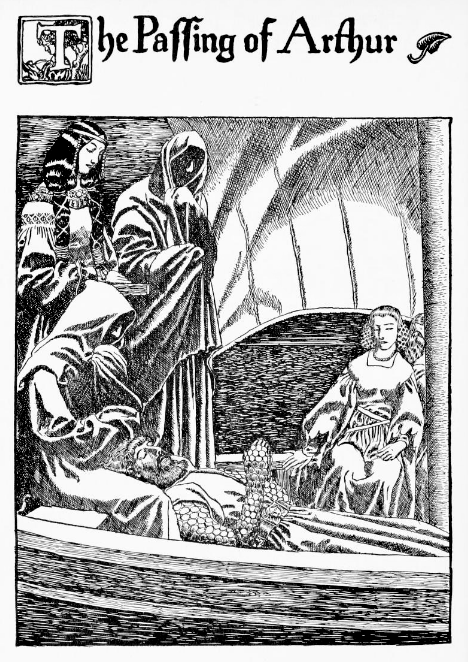
The Death of Arthur. Illustration by Howard Pyle. Source: Wikimedia Commons. Public domain.
Perhaps the most important figure within the **Celtic** tradition, King Arthur was probably, from a historical point of view, no more than a modest warrior chieftain who lived around the year 500 AD, at the time when the Britons were fighting against the Saxon invaders.
It is possible that the achievements of the historical Arthur were so numerous that legend gradually invaded his memory, greatly exaggerating his deeds and elevating him to the status of a mythological figure.
Arthur, which means _"one who has the appearance of a bear"_, acquired all the characteristics of a divinity in accordance with Celtic tradition. The myth then transformed the figure, especially in British Cornwall, where he originated, as well as in the south of Wales.
From that point on, the myth passed through oral accounts to other Celtic countries — accounts that were taken up in the twelfth century by French historians and novelists patronised by Eleanor of Aquitaine and Henry II Plantagenet, who claimed to be the heirs of King Arthur.
This explains the birth and spread across several European countries of what is known as the novels of the Round Table, or the Arthurian cycle. The original framework is completed by other myths of Celtic origin which, taken together, make Arthur the symbol of the Celtic universe, so that everything revolves around the figure of the king.
The power of the king in the Celtic context emanates from his presence even when he is not acting. This explains the aspect of Arthur as a balancer of the natural world and social forces that emanates from him in the twelfth-century texts; it also accounts for his association with Merlin the wizard, whose image reflects that of the ancient druid. In short, **Arthur and Merlin form the famous wizard-druid pair without which no Celtic society can exist**, a pair that corresponds in Hindu mythology to the dual character of the royal and divine function represented by Mitra and Varuna.
The Round Table
In all the novels of the Round Table, Arthur's role is decidedly passive. Indeed, it is his knights who act in his name; moreover, it is Queen **Guinevere** who holds Sovereignty.
The most archaic antecedent of Arthur is considered to appear in the Welsh tale _Kulhwch and Olwen_. In this tale, Arthur is not yet a courtly king surrounded by knights, but a chieftain entirely surrounded by figures from Celtic mythology: warriors and wizards. As the myth modernises, the image of the king is gradually transformed. Arthur thus takes on the attributes of a feudal monarch, and his court becomes the space in which cultivated spirits combine worldliness with valour. Nevertheless, Arthur remains a figure of popular tradition, above all in Cornwall.
Arthur, symbol of the lost power of the Celts, cannot have died; he remains on the **isle of Avalon**, the paradise of the Celts, or perhaps in some cave... or somewhere on the island of Britain. One day the king will return, and with him the unity of the Celtic world. In this way, a horizontally organised society would be rebuilt, one definitively opposed to the Roman spirit. In that society, each person would find freedom and independence within a great confederation of peoples bound by common interests.
Avalon, a Magical Space/Time
_Arthur rests in peace in Avalon, watched over by four fairy queens. Fata Morgana, dressed in black, consults her book of magical arts to heal the wounds of the "immortal" King. In the background, Merlin and the Lady of the Lake. "The Death of King Arthur", James Archer._
Avalon, which etymologically derives from the word for "apple" in Celtic, refers to the magical island on which apple trees bear fruit throughout the year.
In the Latin text by Geoffrey of Monmouth, _Vita Merlini_ (twelfth century), the island is called _Insula Pomorum_.
Avalon is the kingdom of Morgana, who exercises her power surrounded by her nine fairy sisters, who have the gift of being able to transform their physical appearance, often into birds.
The myth tells that Morgana can transform herself into a raven, or into a crow. She is thus assimilated to the Irish tale of the Morrigan, or of Nondh, a Tuatha Dé Danann, who often appears in the form of a crow.
Avalon is a space similar to the _"galisenae"_ of the island of Sein, where prophetesses and sorceresses communicated with Greek and Latin authors. The theme also appears in the _"Island of Women"_, Emain Ablach (Emain of the Apple Trees), about which Irish sailors brought back fabulous tales.
The Island is indeed recycled for the legend of the Arthurian cycle. Avalon thus becomes the dwelling to which the fairy Morgana brings her brother King Arthur, mortally wounded at the battle of Camlann, to keep him _"sleeping"_ until the times allow his return to the world of mortals.
It should be noted that subsequently, under the influence of Christianity (Cluniac monks) and also at the behest of Henry II Plantagenet, the monks of Glastonbury Abbey claimed that a place which was a kind of island amid the marshes was the mythical isle of Avalon. They _"discovered"_ there the tomb of Queen Guinevere and that of King Arthur, which can still be found today among the ruins of the ancient monastery.
Guinevere and Morgana
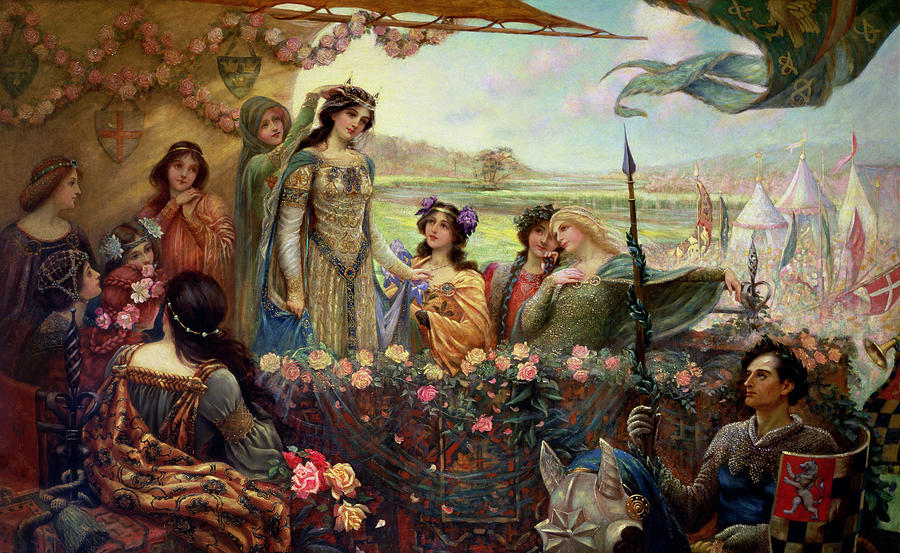
Lancelot and Guinevere. Herbert James Draper. Source: Wikimedia Commons. Public domain.
_Guinevere is crowned Queen of May with a garland. At the May Festival, Arthur and his knights celebrated games and tournaments._
Guenevere, the wife of King Arthur, has achieved fame through her love affair with **Lancelot of the Lake**, since it is precisely because of him that the break between the king and his knight occurs, weakening Arthur and hastening his downfall.
A Queen of Many Lovers
From the perspective of the oldest Welsh and French texts, the story is somewhat more complex. Apparently, she had other lovers before Lancelot (a figure introduced late into the original framework of the legend). In this respect, Guinevere is comparable to Queen Medbh of Connacht, who had love affairs with the warriors upon whom her kingdom depended. Among the list of lovers were: Edern, Kai, Meleagant, and Mordred.
Guenevere thus represents Sovereignty, so that, as a sacred prostitute, she disposes of her sovereignty by entrusting herself to the warriors who watch over it. For it is they, and no others, who perform the necessary deeds in the name of the kingdom that Guinevere embodies and symbolises.
In other texts of insular origin, three different images of Guinevere are reflected, with whom Arthur would have married in succession. The third would have the appearance of an old woman whom Arthur would transform into a beautiful woman in order to overcome the repugnance he felt at being obliged to kiss her. This is a common theme in Irish legends concerning the designation of the king, who must choose Sovereignty beyond all appearances.
The Disciple of Merlin
Morgana is the half-sister of King Arthur, a fairy of fearsome powers who hates Guinevere because she is in love with Lancelot, whom she relentlessly pursues before taking her revenge on him. It is for this reason that she casts a curse on the _"Valley of No Return"_ and schemes persistently against Arthur. But when he is gravely wounded at the battle of Camlann, she decides to take him to her kingdom on the isle of Avalon (the Celtic vision of the Other World), and to keep him sleeping until more auspicious times.
The name Morgana comes from a Breton word, "Morigena", meaning _"born of the sea"_, which refers to a divinity linked to the ocean. Although there are those who point out that her name derives from the Gaelic "Morrigan", whose meaning is _great queen_.
Merlin
_Merlin beside the Lady of the Lake (Detail from "The Death of King Arthur", James Archer)_
It is believed that the literary figure of **Merlin** had his antecedent in a real person who lived seventy years after the historical Arthur. Apparently, he would have been a minor king among the Britons of the north in lowland Scotland, who, going mad after defeat in battle, took refuge in the forests in the grip of a mystical delirium.
Legend then took hold of him and turned him into a mythological figure. Various mythological elements were added to the composition of his personality:
a. The theme of the "madman" inspired by the divinity
b. The theme of the wild man, secluded on the margins of civilisation, lord of animals and balancer of nature
c. The theme of the newborn child who speaks to reveal the future
d. The theme of the wizard
In the elaborated version of the legend, Merlin is the son of an incubus devil, which explains his supernatural power. When Merlin opposes the usurper king **Vortigern**, he serves and advises Emrys Gwledig and becomes the permanent counsellor and titular wizard of Uther Pendragon. He thus causes the latter to father Arthur and ensures that Arthur is recognised as king among the Britons. Merlin will be the one to advise him and help him carry forward his enterprise.
Merlin is said to be the complete druid, since, endowed with enormous powers, he forms together with the king a sacred pair whose destiny is to govern society.
The name Merlin probably derives from the French word _merle_ (blackbird), as the result of a phonetic contamination with the Welsh name _Myrddin_.
The legend of Merlin was integrated into the Arthurian tradition at the beginning of the twelfth century by the Welsh cleric Geoffrey of Monmouth. Among the figures who influenced the definitive image of Merlin, one may mention the Irishman Suibhne, the Scotsman Lailoken, and the Welshman Gwydion.
Lancelot and Guinevere
His love affair with Queen Guinevere generates a scandal that forces him into exile. Upon returning with his clan to Armorica, he brings about a weakening of Arthurian society.
Lancelot, Some Interpretations of the Character
A recent thesis sees Lancelot as a heroic apologia for a sixth-century hermit, Saint Frambald or Framburg, who gave rise to the birth of the district of Passais, on the border of Maine with Normandy.
But in reality, Lancelot du Lac, whose true name is Galahad, is not only the perfect model of the courtly knight but also the heroic image of an ancient Celtic divinity: **Lug**. Many points in common with the Irish hero **Cú Chulainn** should be noted: he does not belong to Arthur's kingdom, since he is a foreigner, and yet Arthur's kingdom cannot subsist without him. **This makes the figure a kind of "functionless" divinity like Lug, or what is called the "multiple craftsman" in the Irish tradition.**
 _Arthur rests in peace in Avalon, watched over by four fairy queens. Fata Morgana, dressed in black, consults her book of magical arts to heal the wounds of the "immortal" King. In the background, Merlin and the Lady of the Lake. "The Death of King Arthur", James Archer._
Avalon, which etymologically derives from the word for "apple" in Celtic, refers to the magical island on which apple trees bear fruit throughout the year.
In the Latin text by Geoffrey of Monmouth, _Vita Merlini_ (twelfth century), the island is called _Insula Pomorum_.
Avalon is the kingdom of Morgana, who exercises her power surrounded by her nine fairy sisters, who have the gift of being able to transform their physical appearance, often into birds.
The myth tells that Morgana can transform herself into a raven, or into a crow. She is thus assimilated to the Irish tale of the Morrigan, or of Nondh, a Tuatha Dé Danann, who often appears in the form of a crow.
Avalon is a space similar to the _"galisenae"_ of the island of Sein, where prophetesses and sorceresses communicated with Greek and Latin authors. The theme also appears in the _"Island of Women"_, Emain Ablach (Emain of the Apple Trees), about which Irish sailors brought back fabulous tales.
The Island is indeed recycled for the legend of the Arthurian cycle. Avalon thus becomes the dwelling to which the fairy Morgana brings her brother King Arthur, mortally wounded at the battle of Camlann, to keep him _"sleeping"_ until the times allow his return to the world of mortals.
It should be noted that subsequently, under the influence of Christianity (Cluniac monks) and also at the behest of Henry II Plantagenet, the monks of Glastonbury Abbey claimed that a place which was a kind of island amid the marshes was the mythical isle of Avalon. They _"discovered"_ there the tomb of Queen Guinevere and that of King Arthur, which can still be found today among the ruins of the ancient monastery.
 _Merlin beside the Lady of the Lake (Detail from "The Death of King Arthur", James Archer)_
It is believed that the literary figure of **Merlin** had his antecedent in a real person who lived seventy years after the historical Arthur. Apparently, he would have been a minor king among the Britons of the north in lowland Scotland, who, going mad after defeat in battle, took refuge in the forests in the grip of a mystical delirium.
Legend then took hold of him and turned him into a mythological figure. Various mythological elements were added to the composition of his personality:
a. The theme of the "madman" inspired by the divinity
b. The theme of the wild man, secluded on the margins of civilisation, lord of animals and balancer of nature
c. The theme of the newborn child who speaks to reveal the future
d. The theme of the wizard
In the elaborated version of the legend, Merlin is the son of an incubus devil, which explains his supernatural power. When Merlin opposes the usurper king **Vortigern**, he serves and advises Emrys Gwledig and becomes the permanent counsellor and titular wizard of Uther Pendragon. He thus causes the latter to father Arthur and ensures that Arthur is recognised as king among the Britons. Merlin will be the one to advise him and help him carry forward his enterprise.
Merlin is said to be the complete druid, since, endowed with enormous powers, he forms together with the king a sacred pair whose destiny is to govern society.
The name Merlin probably derives from the French word _merle_ (blackbird), as the result of a phonetic contamination with the Welsh name _Myrddin_.
The legend of Merlin was integrated into the Arthurian tradition at the beginning of the twelfth century by the Welsh cleric Geoffrey of Monmouth. Among the figures who influenced the definitive image of Merlin, one may mention the Irishman Suibhne, the Scotsman Lailoken, and the Welshman Gwydion.
 His love affair with Queen Guinevere generates a scandal that forces him into exile. Upon returning with his clan to Armorica, he brings about a weakening of Arthurian society.